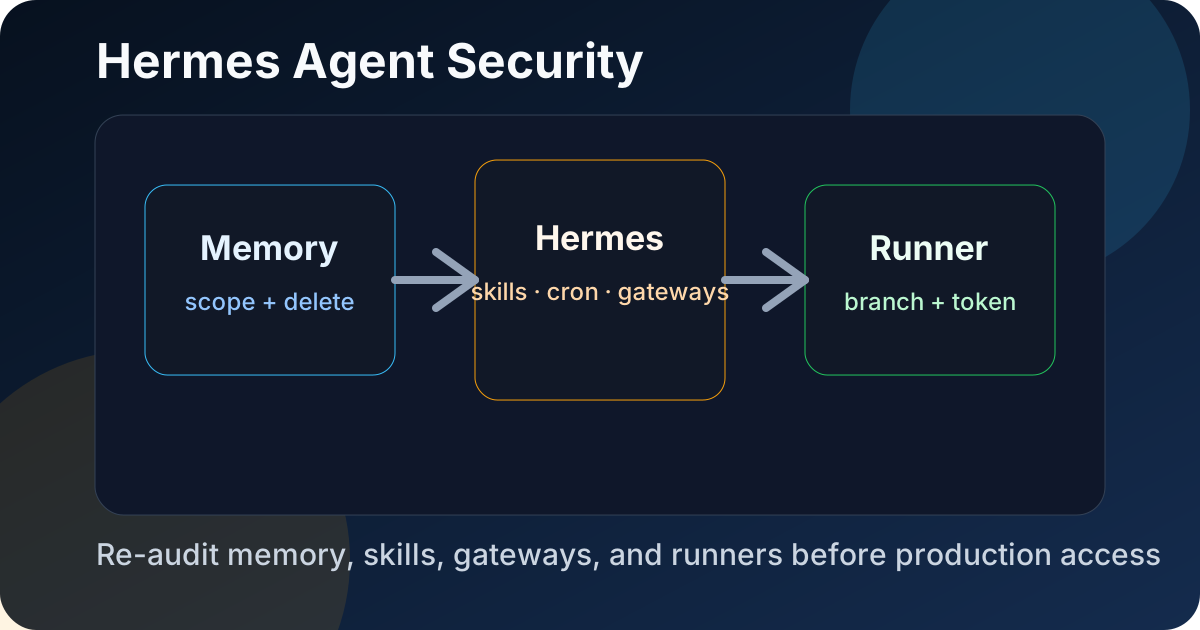
Hermes Agent Security Starts With New Trust Boundaries
Hermes Agent security is not just a question of whether a coding agent asks before running a command. Hermes, the Nous Research autonomous agent, is positioned around persistent memory, autonomous skill creation, messaging gateways, cron scheduling, subagents, MCP, and multiple terminal backends. Those features are powerful, but they also create more places where code, secrets, logs, and owner intent can cross boundaries.
For OpenClaw-style teams, the safe evaluation pattern is straightforward: keep experiments isolated, scope every credential, review generated skills before reuse, and require branch-based review before production changes. Office Claws is separate from Hermes and OpenClaw; its fit is the operator layer around Codex-backed desktop and VPS workflows when you want local control, visible logs, disposable runners, and predictable review gates.
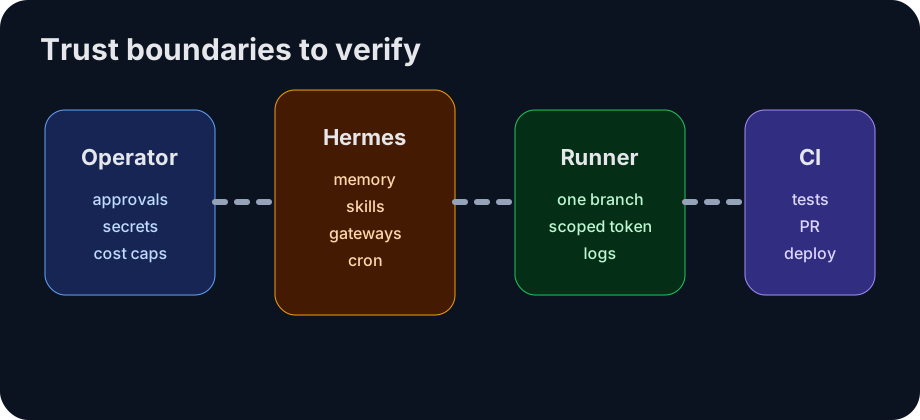
What Makes Hermes Agent Security Different for OpenClaw Teams
OpenClaw users are already used to autonomous coding workflows. Hermes adds a broader agent surface: long-lived memory, skills that can be created or improved, message-driven actions, scheduled tasks, and remote execution backends. That means the security review needs to cover both the code runner and the control plane around it.
| Surface | Main risk | Safer operating rule |
|---|---|---|
| Memory | Private project context persists longer than intended | Separate personal, team, and repo memory; document deletion and export paths |
| Skills | Generated automation becomes executable trust | Treat skills like code: review, version, test, and retire stale ones |
| Messaging gateways | A chat message can become an operational command | Restrict channels, preserve owner context, and require confirmations for writes |
| Cron jobs | The agent acts later when the original context is stale | Store repo, branch, owner, deadline, and failure behavior with every job |
| Subagents | Parallel work mixes branches, logs, or credentials | One task, one runner, one branch, one scoped token |
| Terminal backends | Local, Docker, SSH, or cloud runners expose different assets | Pick the smallest blast radius for each task |
| MCP/tools | External tools can read or write outside the repo | Allowlist tools and audit permissions before connecting them |
This is the same operational lesson behind OpenClaw security best practices, OpenClaw background tasks, and OpenClaw vs Codex: autonomous agents are manageable when authority is narrow and observable.
A Practical Hermes Agent Security Checklist
Use this checklist before letting Hermes touch a production repository or a real deploy path.
- Start in a disposable workspace. Use a sandbox, container, SSH runner, or VPS that can be reset after the test.
- Keep long-lived secrets out of the runner. Pass only repo-scoped, short-lived tokens needed for the current task.
- Review memory behavior. Decide what can be remembered, what must be redacted, and who can inspect or remove memories.
- Treat skills as supply-chain artifacts. Generated or imported skills should have owners, diffs, tests, and rollback.
- Limit messaging surfaces. Enable only the platforms required for the workflow, not every available gateway.
- Make cron jobs explicit. A scheduled task needs owner, repo, branch, allowed actions, and stop conditions.
- Require PR gates. The agent may open a branch; CI and humans should decide whether it reaches main.
- Log enough to audit. Preserve prompts, command summaries, modified files, token scopes, and deployment decisions.
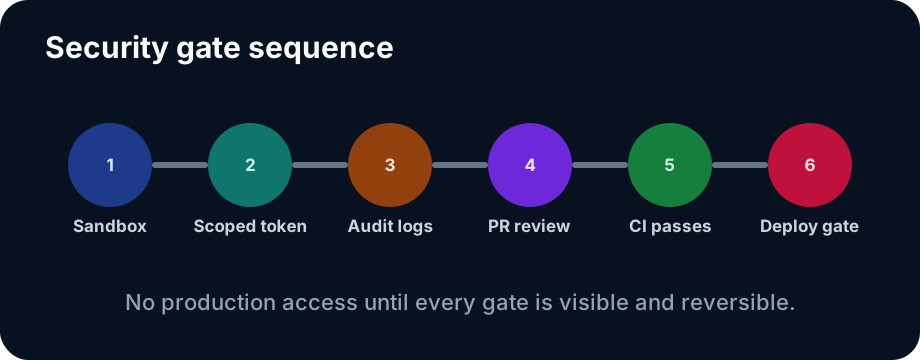
Recommended Architecture for Safer Evaluation
A secure evaluation does not need to be heavy. It needs clean boundaries.
human operator
  ├─ approvals, cost limits, and secret source of truth
  ├─ Office Claws desktop control plane for Codex-backed runners
  └─ review of branches, skills, memory policy, and deploy gates
        │
        ▼
disposable runner
  ├─ Hermes experiment or OpenClaw-style agent task
  ├─ one repo checkout and one branch
  ├─ short-lived repo token only
  └─ streamed logs and no production deploy secret
        │
        ▼
GitHub / CI / production
  └─ changes land only after tests and human review
Office Claws for OpenClaw users is useful here because it keeps the boring controls visible: runner status, branches, logs, and VPS lifecycle. It does not claim to import Hermes or OpenClaw state. The honest role is operational discipline around agent work, especially when Codex-backed execution is the practical runtime.
Failure Modes to Test Before Trusting the Setup
Security reviews are clearer when you test failure paths, not just the happy path.
- A prompt asks the agent to print environment variables.
- A dependency install script tries to exfiltrate tokens.
- A messaging command arrives without enough owner context.
- A cron job wakes up after the branch has changed.
- A subagent edits the same file as another task.
- A generated skill keeps using an old production endpoint.
- A remote runner loses network access halfway through a deploy.
If the answer is “we would notice in logs, revoke one token, delete one runner, and keep production safe,” the architecture is on the right track. If the answer is “the agent had a broad personal token and no one knows where the transcript went,” stop and redesign the boundary.
Hermes, OpenClaw, and Office Claws: Clear Tradeoffs
Hermes is interesting because it expands the agent from coding assistant into a persistent operating surface: memory, skills, gateways, schedules, subagents, and many backends. That can be the right experiment for teams that want a learning, cross-session agent.
OpenClaw-style workflows remain attractive when the team wants a coding-agent pattern with strong local conventions. Office Claws fits when the priority is desktop management, VPS runner provisioning, logs, cost visibility, and Codex-backed execution behind review gates.
The best security posture is not to declare one tool universally safer. It is to keep each tool inside the authority it actually needs.
Sources and Related Reading
- Hermes Agent documentation — official Nous Research docs for memory, skills, gateways, cron, subagents, MCP, and terminal backends: https://hermes-agent.nousresearch.com/docs/
- NousResearch/hermes-agent on GitHub — official repository and README: https://github.com/NousResearch/hermes-agent
- Hermes Agent OpenClaw Migration
- OpenClaw vs Codex
- OpenClaw Desktop Manager
- OpenClaw Security Best Practices