Why an OpenClaw Glossary Helps Teams Move Faster
OpenClaw-style agent work creates a new vocabulary quickly: runners, sandboxes, approvals, checkpoints, gateways, local-first control, and Codex-backed execution. If a team uses those words differently, the agent setup becomes harder to review than the code it writes.
This glossary gives us shared language for safe autonomous coding operations. Office Claws is not a native OpenClaw runtime; it is the practical desktop and VPS operator layer for OpenClaw-adjacent workflows, especially when Codex is the execution path that fits the team. Start with OpenClaw vs Codex for runtime tradeoffs, then use this reference to align the operating model.
Core OpenClaw Terms
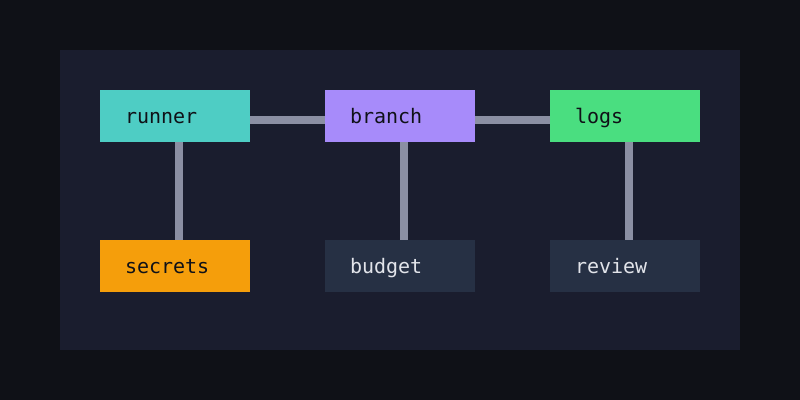
| Term | Plain meaning | Office Claws operating note |
|---|---|---|
| Agent | The coding worker that reads, edits, tests, and reports | Treat it as powerful but bounded, not as an owner |
| Runner | The local machine, VPS, or isolated environment where the agent executes | Use one task per runner when risk is high |
| Worktree | The checked-out repository state an agent mutates | Start clean and keep unrelated diffs out |
| Branch | The reviewable line of work pushed back to Git | Prefer small branches with clear validation |
| Checkpoint | A short progress record with evidence and next step | Require it before long waits, deploys, or broad refactors |
| Approval gate | A human decision point before risky action | Never hide secrets, deletes, or deploys behind automation |
| Blast radius | The maximum damage a mistake can cause | Reduce it with scoped credentials and isolated runners |
The safest habit is to connect every term to an observable artifact: a branch, a log stream, a validation command, or a reviewer decision. Office Claws for OpenClaw users is built around that visibility rather than invisible terminal sessions.
Runtime and Infrastructure Vocabulary
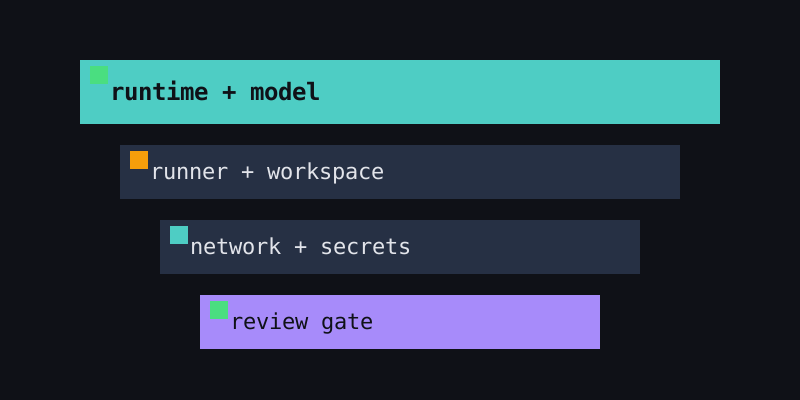
OpenClaw conversations often mix product, model, and infrastructure terms. Keep them separate when planning work.
runtime = the tool or agent interface
model = the provider doing the reasoning
runner = where commands execute
workspace = the files the runner can touch
network = what the runner can reach
secrets = credentials available to the task
review_gate = who accepts or rejects the output| Question | Term to clarify | Safer default |
|---|---|---|
| Where does code run? | Runner | VPS or local workdir per task |
| Who pays for tokens? | Model/provider budget | Per-task budget and usage tracking |
| What can the agent change? | Workspace scope | Repository path allowlist |
| Can it deploy? | Approval gate | Human approval only |
| Can it read secrets? | Secret scope | Minimal, task-specific credentials |
For architecture patterns, pair this glossary with OpenClaw remote runner architecture and OpenClaw sandbox.
Security and Review Terms
Security language matters because agent mistakes usually happen at boundaries. A prompt can sound harmless while a command crosses into production, reads a shared .env, or rewrites unrelated files.
| Security term | What it means | Team rule |
|---|---|---|
| Local-first | Keys and control stay on the operator machine where possible | Do not centralize secrets just to make agents convenient |
| Scoped token | Credential limited by service, repo, or task | Rotate and revoke after the job if practical |
| Sandbox | Isolated workdir, container, or VPS boundary | Use for untrusted dependencies and broad edits |
| Audit trail | Durable record of prompts, commands, diffs, and approvals | Keep enough evidence for code review |
| Stop rule | Condition that forces the agent to pause | Secrets, destructive migrations, deploys, repeated failures |
This is the vocabulary behind OpenClaw security best practices and OpenClaw secrets management: autonomy is useful only when the review path remains understandable.
How to Use This Glossary in a Team
Add the terms to task templates, pull request descriptions, and runbooks. A small shared checklist prevents most confusion:
task: <one sentence>
runner: <local | vps-name>
branch: <branch-name>
budget: <time + token limit>
workspace_scope: <allowed paths>
validation: <commands to prove the work>
stop_rules: <when the agent must pause>
reviewer: <human owner>
When the team can fill this in before work starts, the agent can move faster without becoming mysterious. Office Claws gives OpenClaw-style teams the desktop view, VPS runner separation, log streams, and Codex-backed execution path needed to make these terms operational instead of theoretical.
Related Reading
- OpenClaw vs Codex — clarify runtime and model tradeoffs.
- OpenClaw desktop manager — manage OpenClaw-style work from a local desktop.
- OpenClaw security best practices — turn security terms into review gates.
- OpenClaw remote runner architecture — map glossary terms to real infrastructure.