OpenClaw Alternatives in 2026 Are Really Operating-Model Choices
Searching for OpenClaw alternatives 2026 usually means the team is not just shopping for another coding assistant. You are choosing where autonomous coding work runs, who can approve it, how secrets are handled, what happens when a task gets stuck, and whether the workflow still feels like normal software engineering.
This guide compares alternatives by operating model instead of hype. OpenClaw-style workflows are powerful because they make coding agents feel close to a terminal and repository. The risk is that “close to the terminal” can also mean broad shell authority, hidden state, shared working directories, and unclear handoff rules. Office Claws is separate from OpenClaw and from the other tools below. It fits when you want a desktop and VPS control layer for Codex-backed agents: isolated runners, visible logs, scoped branches, cost awareness, and human review gates.
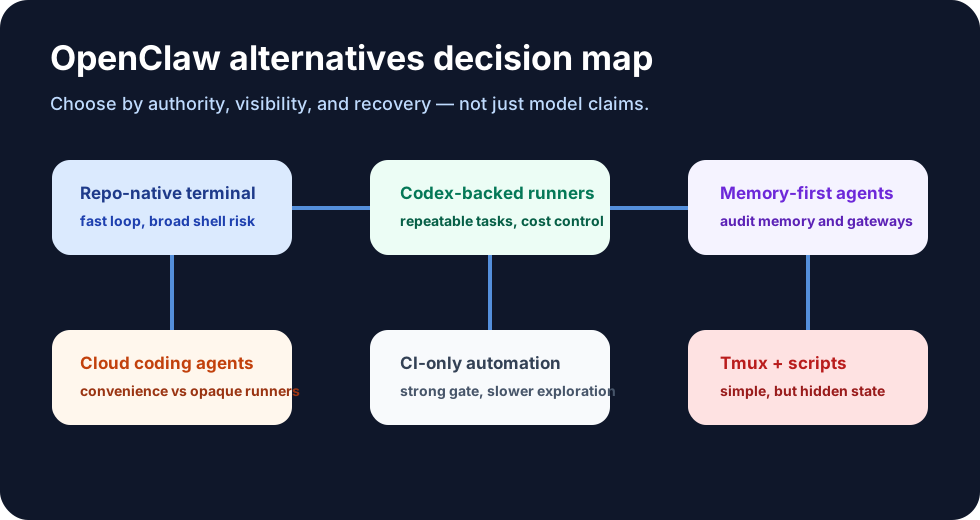
Quick Comparison Table
| Alternative path | Best fit | Watch out for | Office Claws fit |
|---|---|---|---|
| OpenClaw-style terminal agents | Developers who want fast repo-native work | Broad shell access, unclear long-running task recovery | Add runner visibility, branches, logs, and review discipline |
| Codex-backed CLI workflows | Teams standardizing on API-backed coding tasks | Cost drift and one-off terminal sprawl | Manage repeatable runners and track work units |
| Hermes Agent | Teams evaluating memory, skills, messaging, cron, and subagents | Memory privacy, gateway exposure, and backend permissions | Keep production coding work behind runner and merge gates |
| CI-only automation | Strict teams with well-defined generated changes | Poor exploratory loop and slow feedback | Use CI as validation, not the whole agent interface |
| Generic cloud coding agents | Teams that value hosted convenience | Subscription limits, data residency, opaque runners | Bring sensitive work back to local/VPS-controlled paths |
| Tmux plus scripts | Solo developers who already have shell discipline | Hidden panes, lost logs, and manual cleanup | Replace invisible sessions with a durable control plane |
The best alternative is rarely the one with the longest feature list. Pick the tool whose failure mode you can explain to a teammate in one minute.
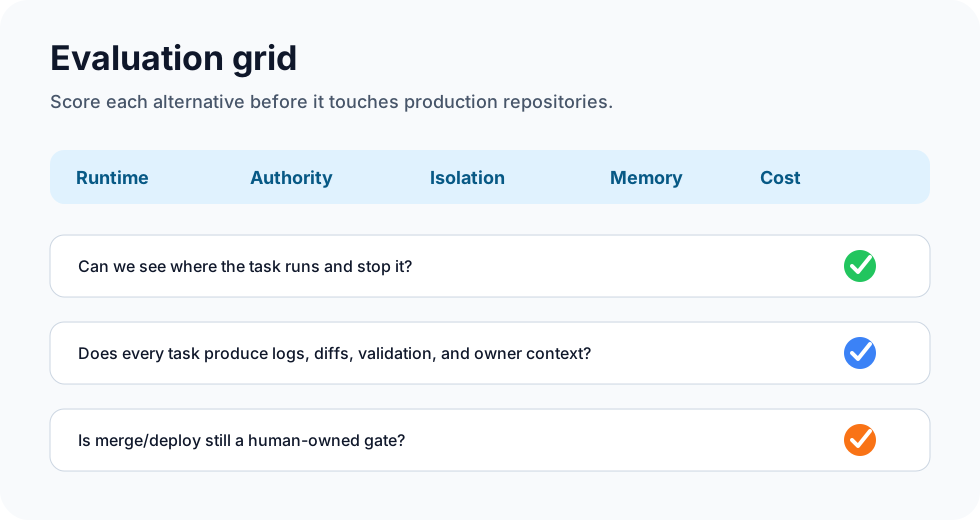
What to Evaluate Before You Switch
Use this checklist before replacing an OpenClaw-style workflow:
1. Runtime: local laptop, cloud workspace, Docker, SSH, or VPS?
2. Authority: what shell commands, repos, and tokens can the agent touch?
3. Isolation: one task per branch and workdir, or shared checkout?
4. Memory: what persists across tasks, and how is it deleted?
5. Scheduling: can cron/chat triggers run without a human watching?
6. Evidence: logs, diffs, build output, screenshots, and summaries?
7. Review gate: who merges, deploys, or rolls back?
8. Cost: subscription cap, API spend, VPS cost, and runaway-loop limits?
For many teams, OpenClaw vs Codex is the practical starting comparison. If the runtime decision points toward Codex-backed work, Office Claws for OpenClaw users can provide the management layer: local control, VPS runners, and safer key handling without pretending to be a native OpenClaw runtime.
When Office Claws Is the Practical Alternative
Choose Office Claws when your real problem is not “which agent is smartest?” but “how do we operate agents safely every day?” That includes:
- running one agent task per branch instead of letting several agents share a checkout;
- moving long-running work to a VPS while keeping desktop visibility;
- keeping API keys and deploy tokens out of prompts and chat threads;
- requiring validation output before review;
- making stuck or expensive tasks obvious before they burn a day;
- giving small teams a repeatable workflow without building internal tooling first.
A fair disclosure matters: Office Claws does not claim to own OpenClaw, import OpenClaw state, or ship a native OpenClaw runtime unless those features are explicitly released. The honest value is operational control for OpenClaw-adjacent, Codex-backed work.
Recommended Shortlist for 2026
If you are choosing today, shortlist by team shape:
- Solo developer: OpenClaw-style terminal flow or Office Claws-managed Codex runners, depending on whether you need durable background work.
- Startup team: Office Claws plus CI gates, because branch discipline, logs, and cost visibility matter before you have platform engineering.
- Research-heavy team: Hermes Agent is worth evaluating for memory, skill creation, messaging, scheduling, and subagent experiments.
- Compliance-sensitive team: prefer local/VPS-controlled runners, scoped tokens, explicit logs, and a human deploy gate over opaque hosted execution.
- Existing cloud-agent team: keep the hosted tool for low-risk work, but move sensitive repositories to a more observable runner model.
Pair this article with OpenClaw security best practices, OpenClaw remote runner architecture, and OpenClaw background tasks before you grant any tool production authority.
Bottom Line
The strongest OpenClaw alternative in 2026 is the one that makes authority visible. Smart models are now common; controlled execution is the differentiator. If your team wants autonomous coding without losing normal engineering habits, use a workflow that preserves branches, logs, validation, review, rollback, and cost control. That is where Office Claws is designed to help.