OpenClaw vs AI coding agents is really a question about operating model. A coding agent can edit files, run commands, and propose a diff. An OpenClaw-style workflow asks the harder questions: where does the task live, who can stop it, which secrets are exposed, what logs are durable, and what proof is required before merge.
Office Claws is not a native OpenClaw runtime. It is the desktop and VPS control layer for teams that want OpenClaw-style autonomy with Codex-backed execution, isolated runners, visible queues, and human review gates. If you are comparing runtimes first, read OpenClaw vs Codex; this guide focuses on how to operate agents safely.
OpenClaw vs AI Coding Agents: The Short Version
Use a generic AI coding agent when the job is small, local, and easy to inspect: generate a test, fix a typo, explain a stack trace, or draft a refactor plan. Use an OpenClaw-style operating model when the work becomes asynchronous, multi-step, security-sensitive, or team-visible.
| Decision | Generic AI coding agent | OpenClaw-style operation |
|---|---|---|
| Control plane | Chat, terminal, IDE, or hosted UI | Queue, runner assignment, approvals, logs |
| Runtime | Often one local checkout | Local desktop plus isolated VPS runners |
| Secrets | Easy to inherit from shell | Scoped, reviewed, and kept out of disposable tasks |
| Collaboration | Diff pasted into normal workflow | Branch-per-task with status and review gates |
| Best fit | Small edits and explanations | Long-running tasks, parallel agents, risky installs |
The distinction matters because agent quality is only one part of production use. A strong model with a weak operating model can still leak secrets, overwrite work, or create a merge queue nobody trusts.
The Four Questions Before You Pick
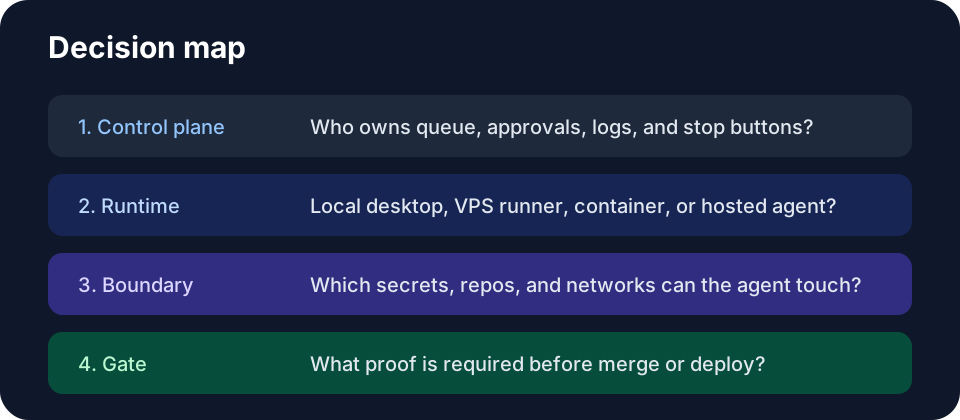
Before you choose OpenClaw, Codex, a hosted coding agent, or an Office Claws-managed runner, answer four questions.
- Who owns the control plane? If the answer is "whoever opened the terminal," the workflow will struggle once two agents run at the same time.
- Where does execution happen? Local is convenient. A VPS is better for long-running builds, disposable dependency experiments, and branches that should survive laptop sleep.
- What is the security boundary? Do not let every task inherit broad
.envfiles, GitHub tokens, cloud credentials, or production deploy keys. - What is the review gate? A task is not done because an agent says it is done. It needs a diff, logs, validation output, and an explicit merge decision.
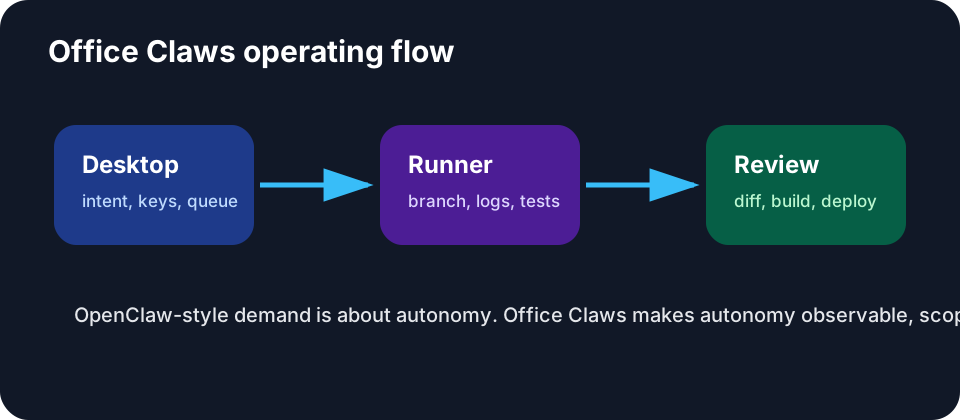
That is the practical reason Office Claws for OpenClaw users separates the local desktop command layer from the runner that touches the checkout.
Where Generic AI Coding Agents Shine
Generic coding agents are excellent at fast, bounded work. They reduce blank-page friction, write first-pass tests, summarize unfamiliar files, and make small changes that a developer can inspect immediately. They are also simpler to onboard because there is less infrastructure to explain.
They become weaker when the task stops being bounded. Long package installs, database migrations, release scripts, flaky tests, parallel branches, and dependency audits need state. They need a place to record what happened. They need isolation from the operator's main checkout. They need a reliable way to pause, kill, resume, or hand off the task.
For those cases, pair the model with an operating layer. Office Claws can keep the task visible while a Codex-backed runner does the execution work on a local machine or VPS.
Where OpenClaw-Style Operations Win
OpenClaw-style workflows win when the team treats agents like junior operators, not autocomplete. The value is not only code generation. The value is repeatable task packaging: one goal, one branch, one runner, one log stream, one validation contract.
A safe operating contract might look like this:
agent_task:
  goal: "add billing retry telemetry"
  branch: "agent/billing-retry-telemetry"
  runner: "disposable-vps"
  secrets: "scoped-readonly-unless-approved"
  validation:
    - "npm test"
    - "npm run build"
    - "human review before merge"
  rollback: "delete runner, keep logs and branch"
This is why teams reading OpenClaw sandbox, OpenClaw remote runner architecture, and OpenClaw background tasks usually care less about a magic prompt and more about durable operations.
Recommendation
Start simple. Use a generic coding agent for tiny local tasks. Move to an OpenClaw-style model when tasks need isolation, uptime, team review, or parallelism. Use Office Claws when you want that operating model without hiding everything in tmux panes, ad-hoc SSH sessions, or unmanaged hosted workers.
Office Claws gives OpenClaw-adjacent teams desktop management, VPS runner provisioning and monitoring, Codex-backed execution, safer local key handling, and clear review gates. That is the difference between "an agent wrote code" and "the team can safely operate agents every day."