Hermes Agent vs OpenClaw Starts With the Operating Model
Searching for Hermes Agent vs OpenClaw usually means you are not just comparing two names. You are choosing how much autonomy to give an agent, where it runs, what it remembers, and how code reaches production.
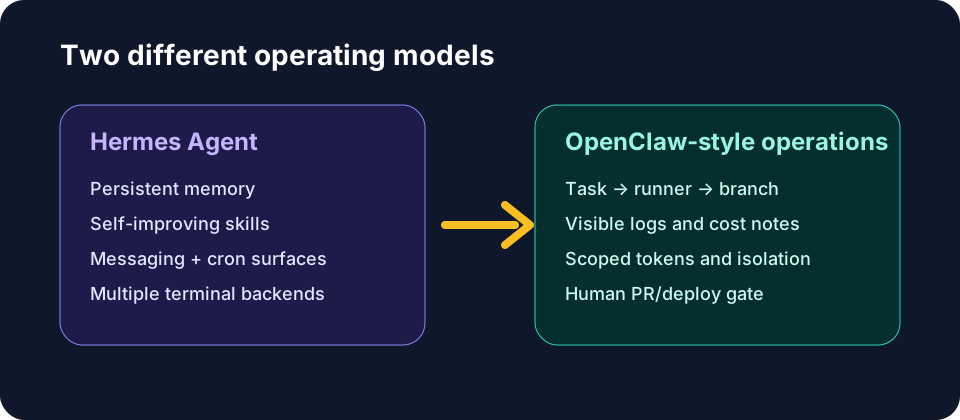
Hermes Agent, from Nous Research, is positioned as a self-improving autonomous agent with persistent memory, skill creation, messaging gateways, cron scheduling, subagents, MCP, and multiple terminal backends. OpenClaw-style workflows are attractive for developers who want autonomous coding habits without losing the familiar branch, terminal, and review loop. Office Claws is separate from both. Its honest role is the desktop and VPS operator layer for OpenClaw-adjacent, Codex-backed work: one runner, one branch, one log stream, and human review before merge.
Hermes Agent vs OpenClaw Comparison Table
| Decision area | Hermes Agent | OpenClaw-style workflow | Office Claws fit |
|---|---|---|---|
| Install and onboarding | Evaluate the Nous docs, gateway, and terminal backend model | Usually CLI/repo conventions plus local setup | Manage desktop/VPS runners without pretending to import Hermes or OpenClaw state |
| Runtime location | Local, Docker, SSH, Daytona, Singularity, Modal, and other documented backends | Local or remote depending on your setup | VPS and desktop runners with visible status, logs, branches, and cost notes |
| Memory model | Persistent memory is a core product idea | Depends on prompts, files, and conventions | Operational context around tasks; not a claimed autonomous memory layer |
| Skills/plugins | Autonomous skill creation and improvement are central claims | Script and prompt conventions vary | Treat reusable skills as reviewed repo artifacts before production use |
| Scheduling | Built-in cron-style operation to audit carefully | Usually external cron, CI, or chat triggers | Useful for scheduled Codex-backed tasks with owner context and review gates |
| Messaging surfaces | Broad messaging gateway story | Usually add-ons or custom bots | Keep chat-triggered coding work scoped to branches and logs |
| Subagents/parallelism | First-class subagent and multi-backend story | Possible, but often hand-rolled | One task per runner/workdir to reduce collisions |
| Security model | Review memory privacy, gateway exposure, approvals, and backend isolation | Review local secrets, shell authority, and repo permissions | Local key handling, scoped tokens, disposable runners, and merge gates |
| Model/provider support | Check current Nous Portal and provider docs | Depends on installed runtime | Codex-backed execution with predictable runner operations |
| Migration path | Includes an explicit OpenClaw migration path in Hermes materials | Existing OpenClaw habits can be preserved manually | Safer place to operate migrated tasks while keeping PR/deploy controls |
The short version: Hermes is the more ambitious autonomous-agent system. OpenClaw-style workflows are the familiar developer pattern. Office Claws for OpenClaw users is the operational control plane when the practical need is safe, observable coding work.
Choose Hermes When Memory and Autonomy Are the Experiment
Hermes is compelling if your real question is whether an agent can improve itself across sessions, accumulate useful memory, create skills, and act through multiple messaging and terminal surfaces. That is a different bet from simply asking an agent to fix one issue in one repository.
A safe Hermes evaluation should answer concrete questions:
- What exactly is stored in memory, and how is it deleted or audited?
- Which messages can trigger shell or repository actions?
- Which terminal backend owns the working directory and credentials?
- Are generated skills reviewed before they become durable behavior?
- Can you reconstruct a failed task from logs without exposing secrets?
Those questions are not anti-Hermes. They are the normal due diligence for any persistent autonomous system.
Choose OpenClaw-Style Workflows When You Want Developer Control
OpenClaw-style workflows make sense when your team already likes the pattern: a task prompt, a working tree, a branch, terminal-visible progress, and a human deciding what lands. The attraction is not just autonomy. It is autonomy that still resembles software engineering.
If you are comparing OpenClaw to other execution paths, start with OpenClaw vs Codex, then map your actual constraints: subscription availability, API cost, runner isolation, and production review. Teams blocked by subscription limits often end up with an OpenClaw migration to Codex rather than a pure tool swap.
The Security Difference That Matters
The risky part of autonomous coding is not the logo in the header. It is the authority boundary. A persistent agent with broad messaging access and durable memory needs a different review model from a one-off coding runner. A local terminal agent with unrestricted repo access also needs controls.
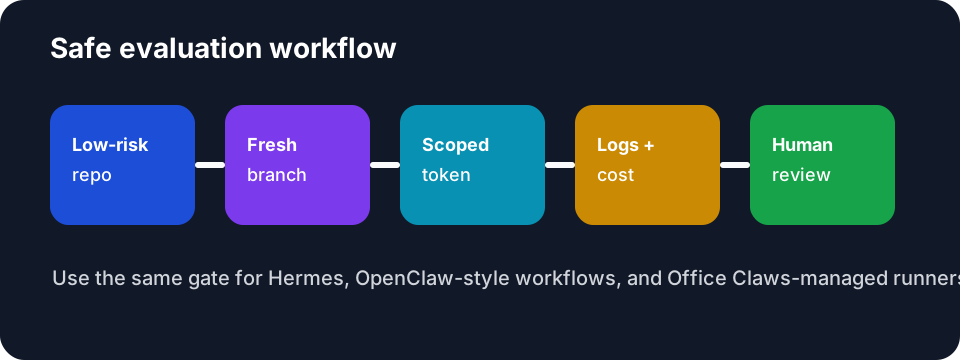
Use this minimum checklist before giving either system real work:
1. use a low-risk repository first
2. create a fresh branch and isolated workdir
3. scope tokens to the smallest repo and action set
4. keep secrets out of prompts, memory, and shared logs
5. require a pull request or human merge gate
6. preserve command logs and cost notes
7. destroy or reset disposable runners after risky tests
Office Claws is strongest in that boring middle: OpenClaw desktop manager, OpenClaw background tasks, and remote runner operations that keep code changes visible instead of magical.
Recommendation
Pick Hermes Agent if persistent memory, self-improving skills, broad messaging, and multi-backend autonomy are the point of the experiment. Pick an OpenClaw-style workflow if you want autonomous coding while keeping the developer loop recognizable. Pick Office Claws when the problem is operating Codex-backed runners safely: scoped workdirs, VPS isolation, cost visibility, logs, branches, and human review.
The best production answer may combine lessons from all three, but the deployment rule should stay simple: do not give any autonomous agent more authority than you can observe, revoke, and review.
Sources and Related Reading
- Hermes Agent documentation: https://hermes-agent.nousresearch.com/docs/
- NousResearch/hermes-agent on GitHub: https://github.com/NousResearch/hermes-agent
- Hermes Agent OpenClaw Migration
- Hermes Agent Security
- OpenClaw vs Codex
- OpenClaw Desktop Manager
- OpenClaw Background Tasks